How the roadmap works
Nature-based solutions are actions that protect, sustainably manage, and restore ecosystems to address societal challenges. A restored floodplain that absorbs stormwater. A green roof that cools a building. An urban wetland that filters water and shelters wildlife.
Unlike single-purpose engineered solutions, they deliver several things at once — across social, environmental, and economic domains. And yet the shift from pilot project to mainstream practice remains fragmented. Interventions stay short-term and externally funded; agencies work to conflicting mandates; institutions default to the concrete they already know how to procure.
Mainstreaming means embedding nature into the core logic of planning, policy, and community practice. This roadmap frames that as a four-stage process, worked through six pathways.
Image:

The four stages of uptake
1. Understanding
People already act for nature, but their practices are not framed as NbS. Language, culture, and lived experience shape how communities relate to nature — often entirely outside formal frameworks.
The work at this stage is bridging the “know-do” gap: aligning scientific definitions with local, traditional, and indigenous knowledge. Residents hold spatial knowledge that external experts do not — historical context, cultural values, everyday observation. In Nairobi's informal settlements, residents practise sack gardening and riparian stabilisation without ever using the term. A roadmap that ignores this starts from zero when it could start from strength.
2. Recognising
Citizen action gains legitimacy, language, and visibility. Communities and institutions begin to see grassroots practices as valid contributions to nature-based approaches.
Recognition is not automatic. It depends on evidence — and on measuring the right things. Conventional infrastructure is judged by narrow, single-purpose metrics. Nature needs an integrated approach: climate resilience, social equity, and economic benefit together. In Wrocław, greened courtyards were tracked for both ecological and social outcomes. Adult use of those spaces rose from 43% to 83%, and 63% of residents reported increased trust in their local authority.
3. Integrating
NbS are embedded in planning, policy, governance, and institutional systems. Cross-sector collaboration replaces siloed approaches.
Nature crosses administrative boundaries — water, parks, health, housing — and often fails when managed by isolated departments. This is also the stage where the risk of exclusion peaks: as participation becomes formal, its formats tend to favour those already comfortable with institutions.
4. Sustained use
Long-term funding, stewardship, ownership, and economic models ensure NbS endure beyond project cycles and political terms.
This is where most initiatives quietly fail. Funding is heavily skewed toward the capital “build” phase — planning, planting, ribbon-cutting — while neglecting the operational costs of community maintenance. The result is high plant mortality and abandoned green space: a system that funds the creation of nature but not its care.
"Community work exists because people are driven to solve a need in their environment and their daily life. If we had institutional support, there would be more motivation to continue because they wouldn't feel alone."
Interviewee 16, Urban Planner, Colombia
Who counts as a citizen?
This roadmap uses “citizen” broadly, to include everyone who engages with — or could engage with — nature in their community. It is not a legal definition. It is a recognition that the people shaping the future of urban and rural ecosystems are far more diverse than formal frameworks acknowledge.
Individual residents, including migrants, youth, elderly people, indigenous communities, informal workers, and low-income groups
Members of grassroots and community organisations
Civil society organisations and NGOs acting as intermediaries between communities and institutions
Informal stewardship networks whose care goes unrecognised — community gardeners, river caretakers, seed-savers, neighbourhood cleaners
Citizens as knowledge producers, through participatory science, environmental monitoring, and lived experience
Image:

"If you translate nature-based solutions to the Dutch… it evaporates, it's a hollow term. We have to think more about a regenerative ecosystem in which we see mankind as part of nature."
Interviewee 2, Landscape Designer, Netherlands
The action cycle
Every pathway is operationalised through the same three-step cycle, which also structures the downloadable Action Check-Off sheets.
Image:

Prepare
Understand before you engage. What do people already know and do? What words do they use for working with nature? Who faces barriers to taking part — of time, language, money, or trust?
Image:

Engage
Do the work, and listen while you do it. The best processes are the ones where the facilitator learns as much as the participants. If a format is not working, change it.
Image:

Reflect
Who came? Who did not? Absence is data. Reflection is not evaluation for a report — it is how learning compounds across cycles.

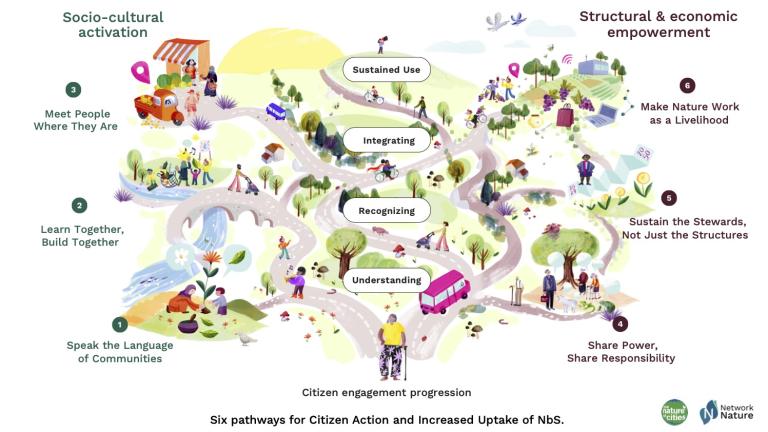

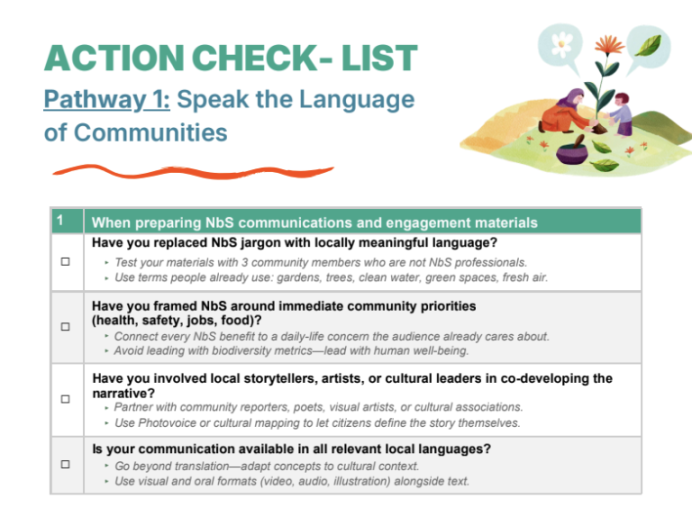
Image:

Image: