Introduction
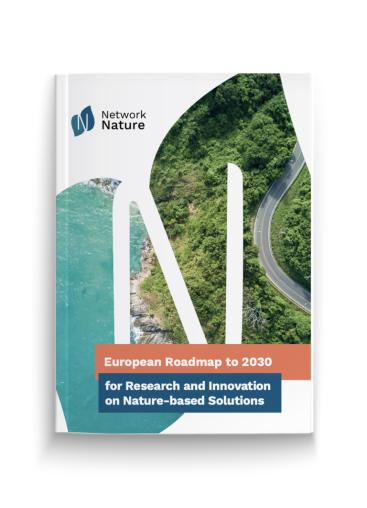
This Roadmap to 2030 identifies core action areas for European Research and Innovation (R&I) on Nature-based Solutions (NbS) that are essential to achieve EU goals for NbS development and deployment.
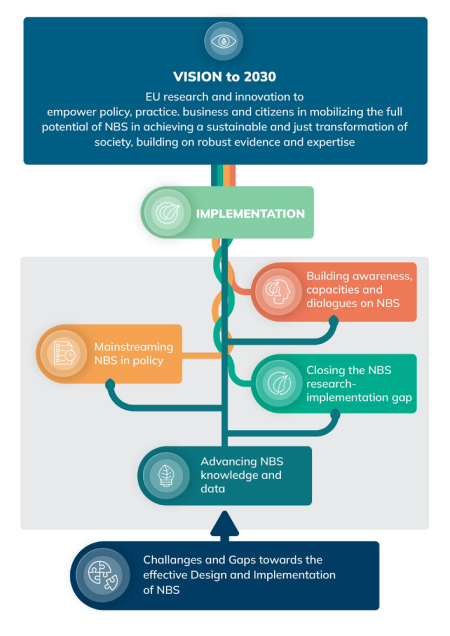
It provides an overview of efforts implemented so far, major knowledge needs and knowledge implementation gaps, and helps lay out and facilitate synergies and complementarities between the past, ongoing, and forthcoming activities of European R&I on NbS. The overarching vision of the roadmap is for EU R&I to empower policy, practice, businesses, and citizens in mobilising the full potential of NbS in achieving a sustainable and just transformation of society, building on robust evidence and expertise.
This visualisation will enable you to navigate through and within the roadmap; guiding you from the context in which it has been set, to the exploration of the diverse pathways where R&I can play a key role for NbS implementation and mainstreaming.
To support the deployment of evidence-based NbS in Europe and globally, and achieve the vision depicted above, four strategic action areas were identified for transdisciplinary R&I:
Image:

Background
About the Roadmap for R&I on NbS
What are NbS?
Need a quick refresh on NbS? Click here to learn more about nature-based solutions!
Why support R&I on NbS?
This roadmap was developed in response to the growing need for collaborative processes among stakeholders at every stage of the Nature-based Solutions (NbS) process, including design, implementation, governance, and monitoring due to their multiple objectives, impacts, and potential for benefits. Research and innovation (R&I) can play a crucial role in exploring action levers and addressing barriers essential for the deployment of NbS and with NbS expected to support the implementation of the EU Green Deal, coordinated knowledge development and implementation are vital to support decision-making and unify European efforts toward common goals.
How as the R&I Roadmap designed?
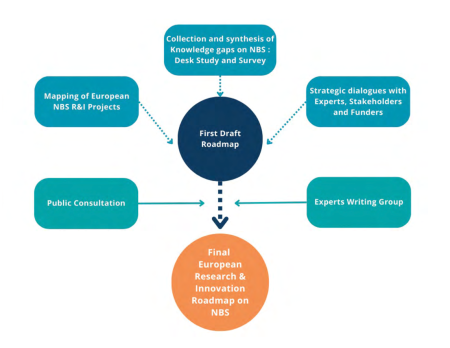
This Roadmap was co-developed with a wide diversity of stakeholders. It draws on NetworkNature’s activities, including a mapping endeavor of European NbS R&I projects and an extensive collection of knowledge gaps identified from literature and stakeholder input.
Image:
Understanding the bigger picture: the socio-political context
NbS have come a long way since their emergence in the late 2000s, finding a wide diversity of applications, for instance in climate mitigation, urban resilience, disaster risk reduction (Cassin & Matthews 2021). Recently, their significance has grown, particularly in response to environmental-related challenges (Davies et al. 2021).
In Europe, this interest surge is mirrored in academic and political publications. Key EU policies, including the European Green Deal, the EU Biodiversity Strategy, the Climate Adaptation Strategy, and the European Commission (EC) Framework Programme for Research and Innovation (e.g., Horizon Europe) prominently feature NbS. Despite this, their integration into sectors beyond environmental and research policies remains limited.
Globally, major organisations such as the Organisation for Economic Co-operation and Development (OECD), the Intergovernmental Panel on Climate Change (IPCC), and the Intergovernmental Science-Policy Platform on Biodiversity and Ecosystem Services (IPBES) have incorporated NbS into their work plans and publications. This growing recognition is also evident in recent strategic documents, specifically the Sharm El-Sheikh Declaration from the United Nations Framework Convention on Climate Change (UNFCCC) and the Kunming-Montreal Global Biodiversity Framework from the United Nations Convention on Biological Diversity (CBD).
Furthermore, research highlights the growing role of “nature-based enterprises” in responding to the increasing demand for NbS, which is supported by the private sector’s growing interest in NbS. However, criticisms such as greenwashing, unequal distribution of benefits or lack of cost-effectiveness persist. These challenges represent strong barriers to NbS deployment, and addressing them requires robust evidence, capacity-building and engagement to harness NbS’s potential for tackling societal challenges while ensuring environmental, social and economic sustainability.
Cassin, J., Matthews, J. H., & Lopez-Gunn, E. Nature-based solutions and water security: An action agenda for the 21st Century. Elsevier Science. (2021).
Davies, C., Chen, W. Y., Sanesi, G. & Lafortezza, R. The European Union roadmap for implementing nature-based solutions: A review. Environ. Sci. Policy 121, 49–67 (2021).
Who should read the Roadmap?
This roadmap is relevant to diverse audiences seeking a comprehensive overview of European research and innovation (R&I) efforts and developments towards 2030 to support the design and implementation of Nature-based Solutions (NbS):
- For the research community, it offers a picture of the latest efforts on NbS at the European level, along with policy-relevant and implementation priorities to refer to and engage with when contributing to the development of the European evidence base on NbS.
- For R&I and implementation programmers and funders working on NbS, this roadmap identifies transdisciplinary research needs and provides a framework for strategic dialogue and development across Europe's diverse NbS R&I landscape.
- For policy, practice and finance, the roadmap outlines major roles and pathways for R&I to help address knowledge and implementation gaps on NbS, and contribute to the development of supportive frameworks and tools for NbS deployment at different scales.
The overarching vision of the roadmap is for EU research and innovation to empower policy, practice, businesses, and citizens in mobilising the full potential of NbS in achieving a sustainable and just transformation of society, building on robust evidence and expertise.
Image:
Taking Stock
Mapping of EU R&I Implementation projects landscape
A mapping of projects: what for?
Mapping the landscape of EU R&I and implementation projects on NbS is essential for building a robust evidence base, showcasing EU support, and guiding future efforts. The first version of the mapping covers major European R&I and implementation programmes, including BiodivERsA, Horizon 2020, Seventh Framework Programme (FP7), Interreg and LIFE (EU’s funding instrument for the environment and climate action) from 2011 to 2021. Updates will extend the initiatives included and the timeframe covered. For detailed methodology, please refer to the Annex 1 of the Roadmap, here.
Key results
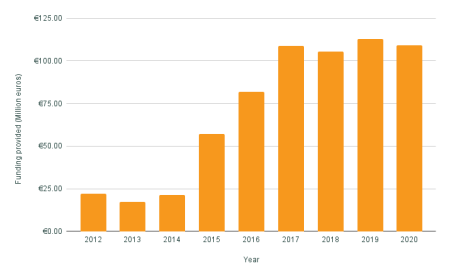
The funding from major EU programs for NbS showed a significant increase from 2011 to 2017, stabilising around 100 million euros annually thereafter. The number of funded projects also tripled during this period and has since remained steady.
Image:
Key findings:
-
Prevalent Solutions’ Types: Solutions based on developing sustainable management protocols and procedures for managed or restored ecosystems (Type 2)* were the most common (50%) – followed by solutions that involve creating new ecosystems (type 3) with 39% and by solutions that involve making better use of existing natural or protected ecosystems (type 1) with 10% of projects.
-
Top Societal Challenges: Climate Resilience (27%) and New Economic Opportunities and Green Jobs (16%) were the most studied societal challenges.
-
Popular Approaches: Issue-specific ecosystem-related approaches (i.e., ecosystem-based adaptation, mitigation, and disaster risk reduction) were prevalent (27%). Green Infrastructure and Ecological Restoration were the most studied specific approaches, representing 20.5% and 18% of all projects, respectively.
- Common Ecosystem Types: Urban (23%) and agricultural land (20%) were the most studied ecosystems, followed by coastal (12,5%) and forest environments (11%).
* Following the typology developed by Eggermont, H. et al. Nature-based Solutions: New Influence for Environmental Management and Research in Europe. GAIA - Ecol. Perspect. Sci. Soc. 24, 243–248 (2015).
Overview of progress in the EU’s 2017 research policy goals on NbS
In 2016, the EC developed a policy roadmap for R&I on NBS around five policy goals, intending to further develop knowledge and uptake of NBS by pursuing dialogues and initiatives. This section provides an overview of several major advancements that took place since the launch of these five objectives.
Enhancing framework conditions – EU policies
The European Green Deal has integrated NbS across various strategies and initiatives (e.g., the European Biodiversity Strategy for 2030, the EU Forest Strategy, and the EU Soil Strategy), recognising them as vital for achieving sustainability goals.
The EU Missions are investing in R&I to promote NbS, specifically t3 Missions are of particular in - interest for NBS:
- Adaptation to Climate Change: support at least 150 European regions and communities to become climate resilient by 2030,
- Restore our Ocean and Waters by 2030
- 100 Climate-Neutral and Smart Cities by 2030
Develop a community of innovators
The EC has fostered a distinct NbS Community through research projects calls under the R&I programs Horizon 2020 and Horizon Europe.
The creation of the NbS Task Forces has been crucial in clustering the growing portfolio of NbS projects. They have been able to gather and synthesise projects’ outputs to enhance their ecological, social and innovation impact while ensuring their policy relevance. The Six Task Forces (TFs) established foster synergies around topical challenges while promoting collaboration and knowledge exchange.
Create and consolidate evidence base
The EC has addressed a wide range of NbS themes within its Work Programmes. It has also encouraged knowledge exchange through the development of platforms and networks, such as NetworkNature, the EU Business@Biodiversity Platform, and the Urban Greening Platform.
An analysis of EU R&I outputs on NbS showcases the cost-effectiveness of NbS, supports policy implementation, and highlights policy recommendations and knowledge gaps.
Advancing the development, uptake, and upscaling of innovative NbS
The EC, EU NbS Task Force and NbS National and Regional Hubs are driving efforts to uptake and upscale NbS through case studies and best practices. National and Regional Hubs focus on local barriers and opportunities for NbS adoption.
Acknowledging the importance of the funding barrier to the deployment of NbS, a recent study led by the European Investment Bank assessed the access-to-finance conditions for NbS, and provided recommendations to attract public and private investments.
Mainstreaming NbS internationally
The EC aims to promote global adoption of NbS. In this line, Sector Dialogues – such as those with Brazil - were organised to facilitate international cooperation and provide regional and policy recommendations, as well as specific calls targeting international collaboration - European projects play a key role in fostering global interactions and collaborations among diverse stakeholders and across regions, contributing to the growing recognition and adoption of NbS internationally, despite remaining reluctance from some governments.
References
Faivre, N., Fritz, M., Freitas, T., de Boissezon, B., Vandewoestijne, S. Nature-Based Solutions in the EU: Innovating with nature to address social, economic and environmental challenges, Environmental Research, 159, 509-518, (2017).
Action Areas
Action Area 1 – Advancing NbS Knowledge and Data
Focused on advancing knowledge and data to enhance the design, implementation, and effectiveness of NbS, this Action Area identifies crucial research thematic areas to reinforce the systemic understanding and evidence-base of NbS – and their co-benefits – and promote their (e)valuation as well as their wider-scale deployment.
Main navigation
- 1a. Advancing knowledge for sustainable and effective NbS design and implementation
- 1b. Improved evidence-base on NbS effectiveness
- 1c. Further developing non-monetary and monetary valuation of NbS benefits and cost
Action Area 2 – Closing the NbS research-implementation gap
This Action Area highlights opportunities to overcome barriers preventing the operationalisation of research outcomes. It offers research recommendations on the enabling environments and supportive tools and standards within both policy frameworks and business contexts.
- 2a. Better integrating research and demonstration
- 2b. Operationalising NbS in business contexts
- 2c. Developing and testing tools to help close the research-implementation gap
Action Area 3 – Mainstreaming the role of R&I in NbS policy
This Action Area identifies strategic opportunities to showcase the role of R&I in enhancing NbS policy implementation across EU sectors and scales, and in promoting supportive governance and policy frameworks at relevant scales. It also underlines how R&I can help shape NbS international agenda and promote transformative change.
- 3a. Advancing policy implementation across EU sectors and scales
- 3b. Enabling supportive conditions and legal frameworks for NbS through R&I
- 3c. EU R&I supporting an ambitious NbS international agenda
Action Area 4 – Exchange, capacity building and awareness
This Action Area emphasises the transformative potential of R&I in empowering society through education and engagement, through co-developing knowledge, fostering participatory approaches and integrating stakeholders’ perspectives.
- 4a. Raising awareness of and empowering society on NbS
- 4b. Enabling transdisciplinary dialogue and local knowledge integration
- 4c. Developing skills and investment capacities for NbS implementation