
From 3 to 5 February 2026, our coordinator (UL) actively participated in the Finance Innovation Festival hosted by the NATURANCE project in Brussels, where the BIOFIN-EU project was promoted alongside leading European initiatives working to advance nature based finance and resilience. Over three intensive days, policymakers, financial institutions, researchers, businesses, and practitioners gathered to explore how finance can better support Nature-based Solutions and accelerate the transition toward a Nature-Positive Economy.
The festival opened with a clear and urgent message. The science, tools, and momentum to support nature based resilience already exist, yet time, scale, and market demand remain major barriers to mobilising sufficient investment. Early discussions highlighted a widening gap between accelerating environmental risks and the slower pace of financial deployment. While enabling policy frameworks are emerging across Europe, practical implementation of finance for Nature-based Solutions continues to face significant challenges.
Day 1, From concept to measurement: driving the transition toward a Nature-Positive Economy
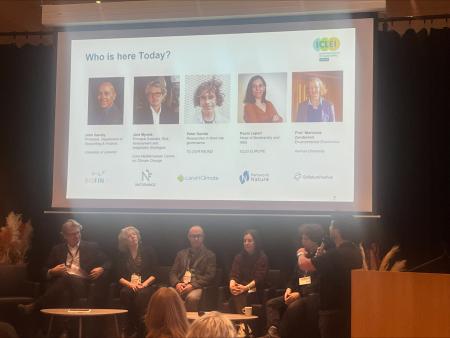
On 3 February, UL contributed to the session “From concept to measurement, driving the transition toward a Nature Positive Economy”, organised by ICLEI Europe. The session gathered around thirty experts, including representatives from European Commission Directorates General, European Parliament offices, financial institutions, corporates, SMEs, insurance companies, leading researchers, Horizon Europe projects such as GoNaturePositive!, NetworkNature, BIO-CAPITAL, Land4Climate, and organisations such as TNFD, the Science Based Targets Network, and the Capitals Coalition.
The session provided a structured space to examine how to measure progress toward a Nature-Positive Economy (NPE) and what science-based policies and legislation could drive and accelerate the transition.
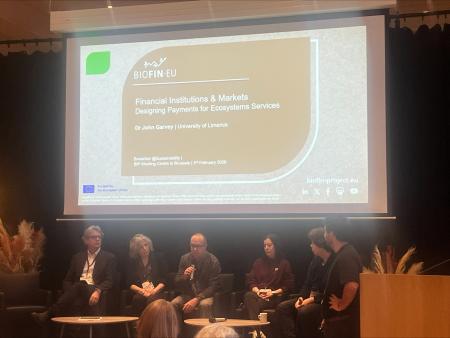
Through interactive group discussions, participants explored guiding principles and their associated indicators, working toward consensus on metrics capable of capturing systemic progress. Breakout “futuring” activities encouraged participants to reflect collectively on future science based policy and legislative pathways required to drive change. The session concluded with a collective debrief connecting envisioned futures with current social, ecological, and economic realities.
Day 2, Designing insurance as a catalyst for nature positive finance, BIO CAPITAL and BIOFIN-EU workshop
During the NATURANCE Festival, an interactive session brought together BIOFIN-EU and BIO-CAPITAL projects, which coordinated a co-creation workshop titled “Designing insurance as a catalyst for nature positive finance”.
With more than thirty participants, the workshop quickly moved from framing challenges to testing ideas. Participants examined how insurance, as a tool that shapes behaviour, could be redesigned to encourage nature positive actions and reduce nature negative outcomes. Working in small groups, they applied design principles to two practical contexts, environmental liability insurance and crop insurance.
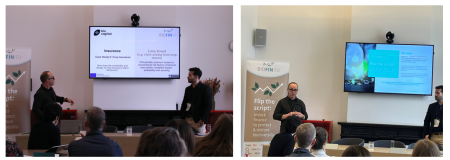
The discussions revealed that insurance can move beyond passive risk transfer. Thoughtfully designed products can reward prevention, finance resilience measures, and create incentives that support long term environmental sustainability.
The session highlighted that transitioning to nature positive finance requires redesigning everyday financial products through continuous dialogue between finance professionals, policymakers, scientists, and practitioners.
Strengthening Momentum for Nature Positive Finance
UL’s participation in the Finance Innovation Festival 2026 demonstrated the growing momentum behind nature based finance initiatives across Europe. By promoting BIOFIN-EU and contributing to key discussions on measurement frameworks, innovative insurance design, and collaborative governance, the project continues to support the transition toward resilient, nature positive economic systems.